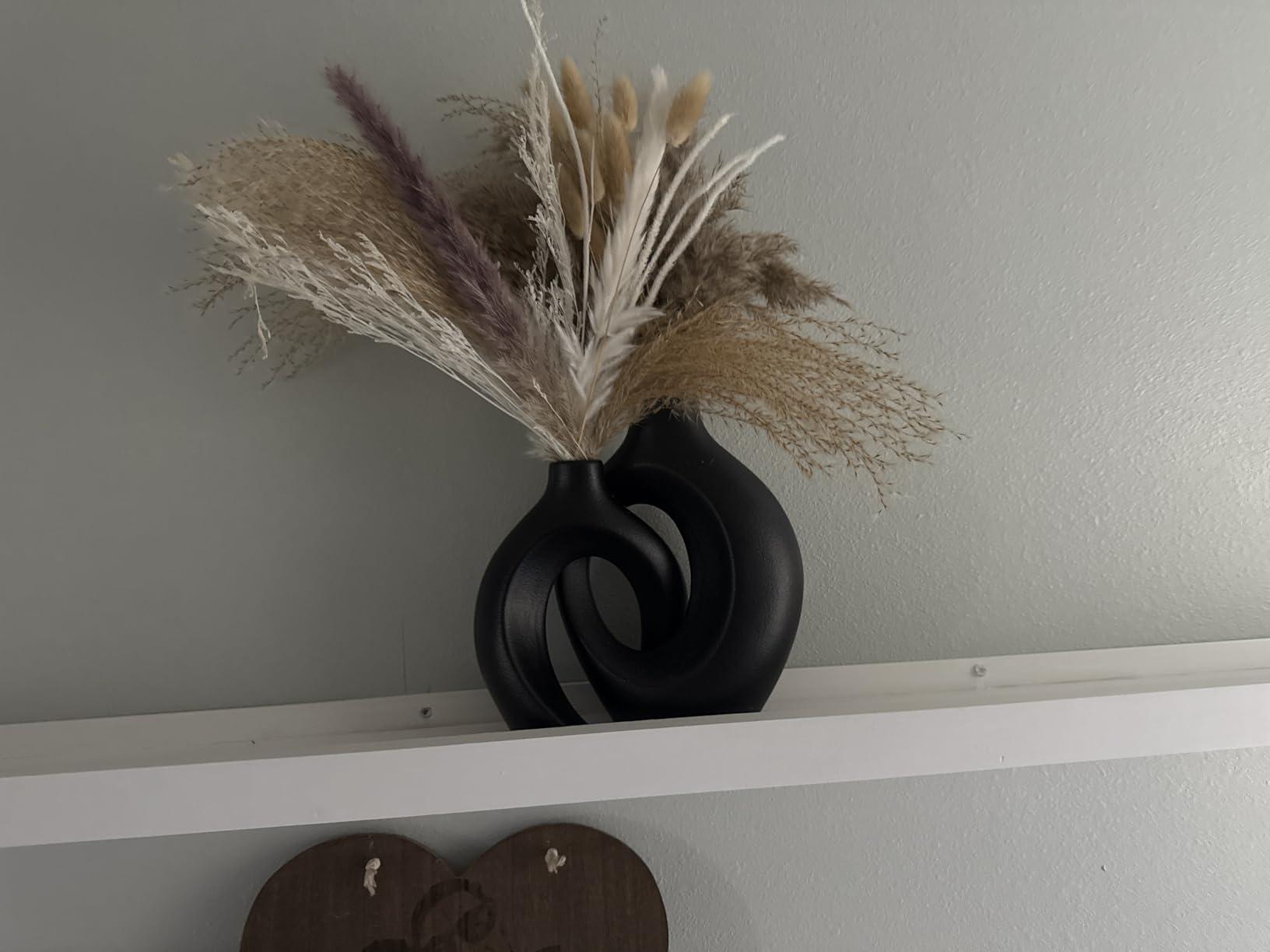
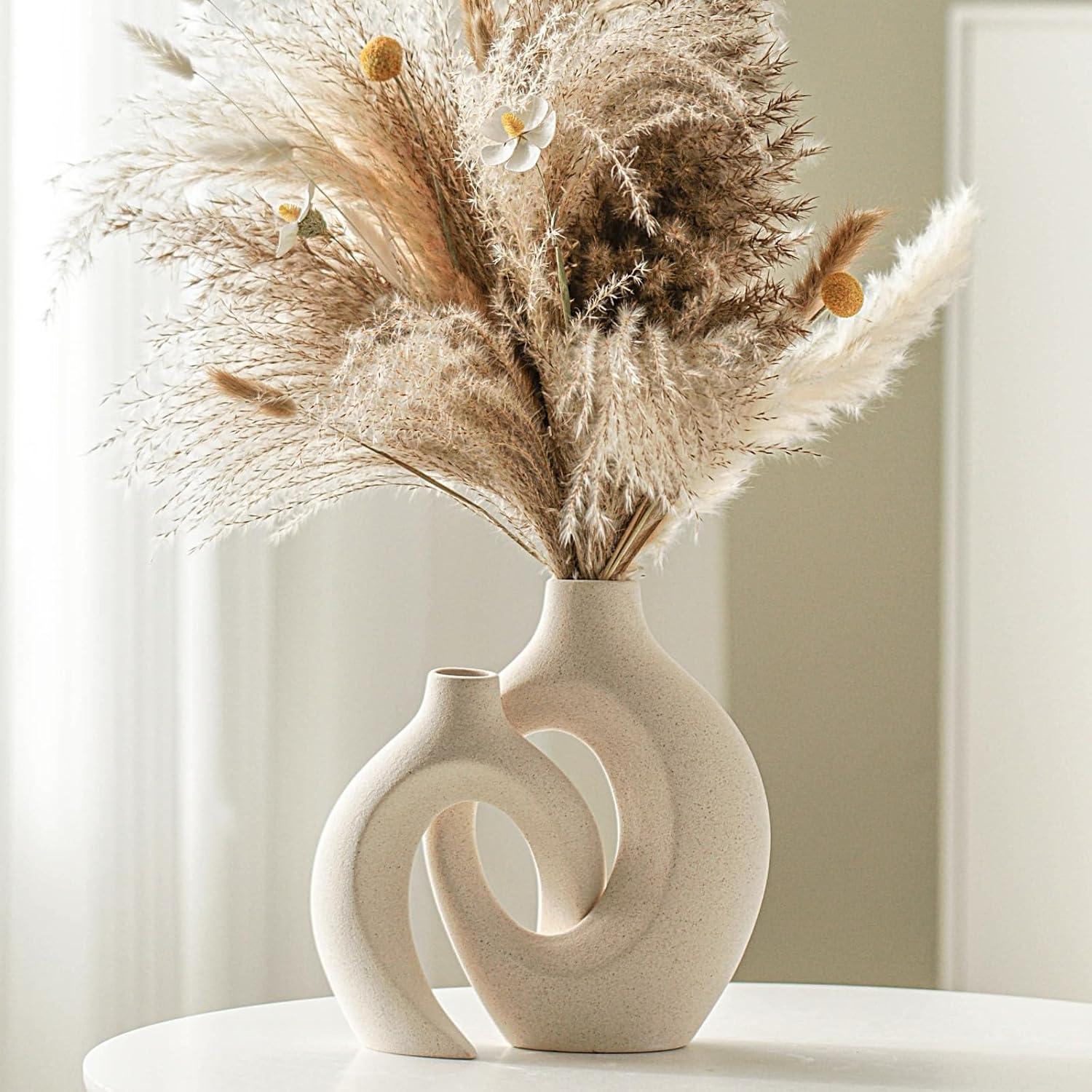
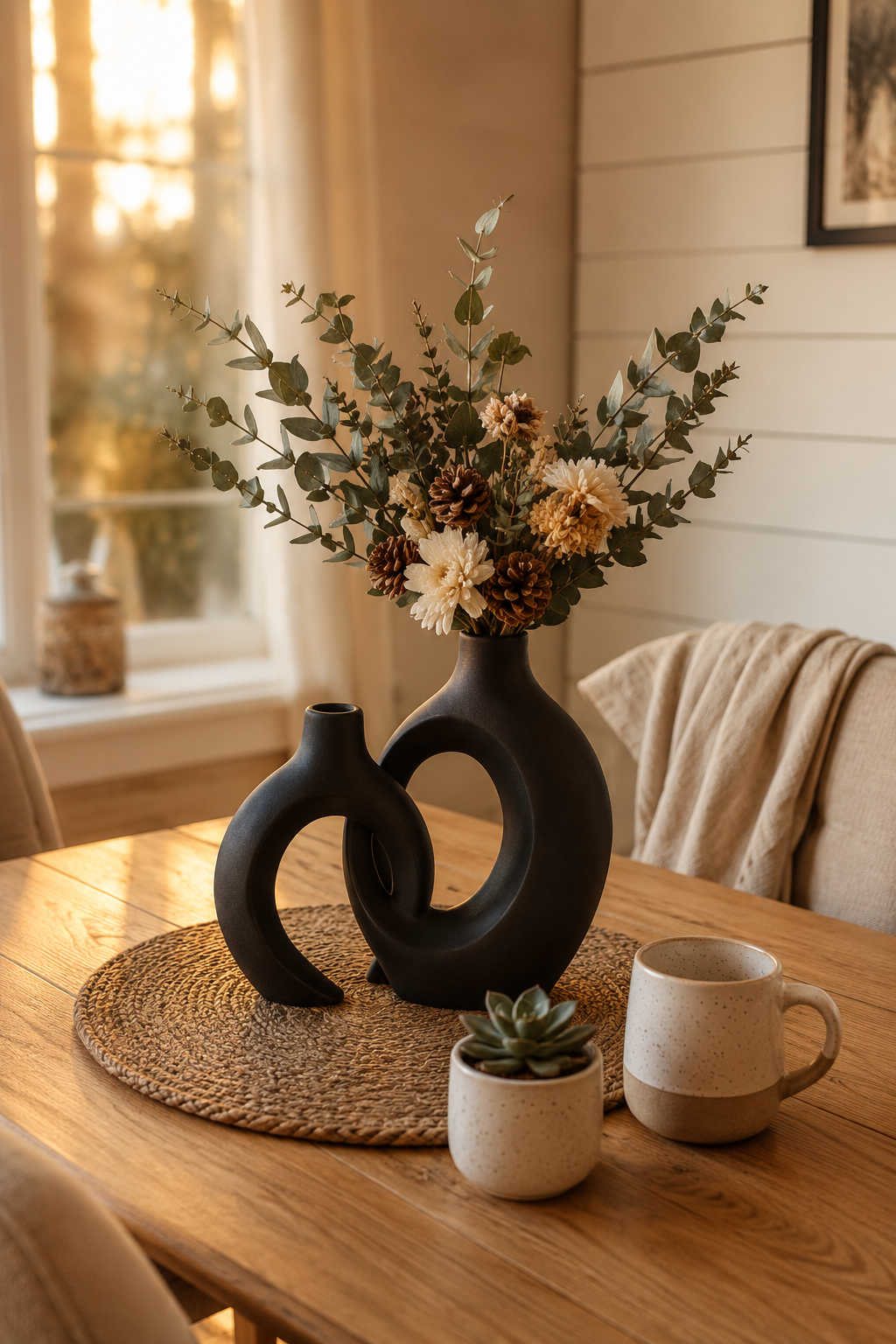
A boho ceramic vase set of two creates balanced shelf and side table styling without the guesswork of mixing singles — but proportion, spacing, and stem choice still matter.
A single vase can finish a shelf. A vase set of two finishes it with balance. The advantage of buying a matched pair is that the sizing, finish, and proportion are already resolved — you skip the slow, often expensive process of finding two singles that look right together. A boho ceramic vase set in milky white is especially useful because it works in almost any neutral room without demanding attention or clashing with existing decor.
I recently helped a friend restyle the floating shelf in her hallway. She had three small objects — a candle, a tiny succulent pot, and a brass letter holder — crowded on 60 cm of oak. We replaced all three with two ceramic vases: one with a single dried eucalyptus stem, one empty. The shelf looked calmer, the hallway felt less cluttered, and she stopped rearranging things weekly. A set makes the decision once.
For the editorial philosophy behind choosing fewer, larger objects, our guide on the quiet power of a single good vase covers the principles in depth. This article focuses on the practical details of choosing, placing, and maintaining a specific type: the Nordic boho ceramic vase set.
Why a Set Works Better Than Two Singles
Buying two individual vases and making them look intentional together is harder than it sounds. The finishes rarely match exactly, the proportions may fight each other, and the scale difference is either too large (they look unrelated) or too small (they look like a mistake).
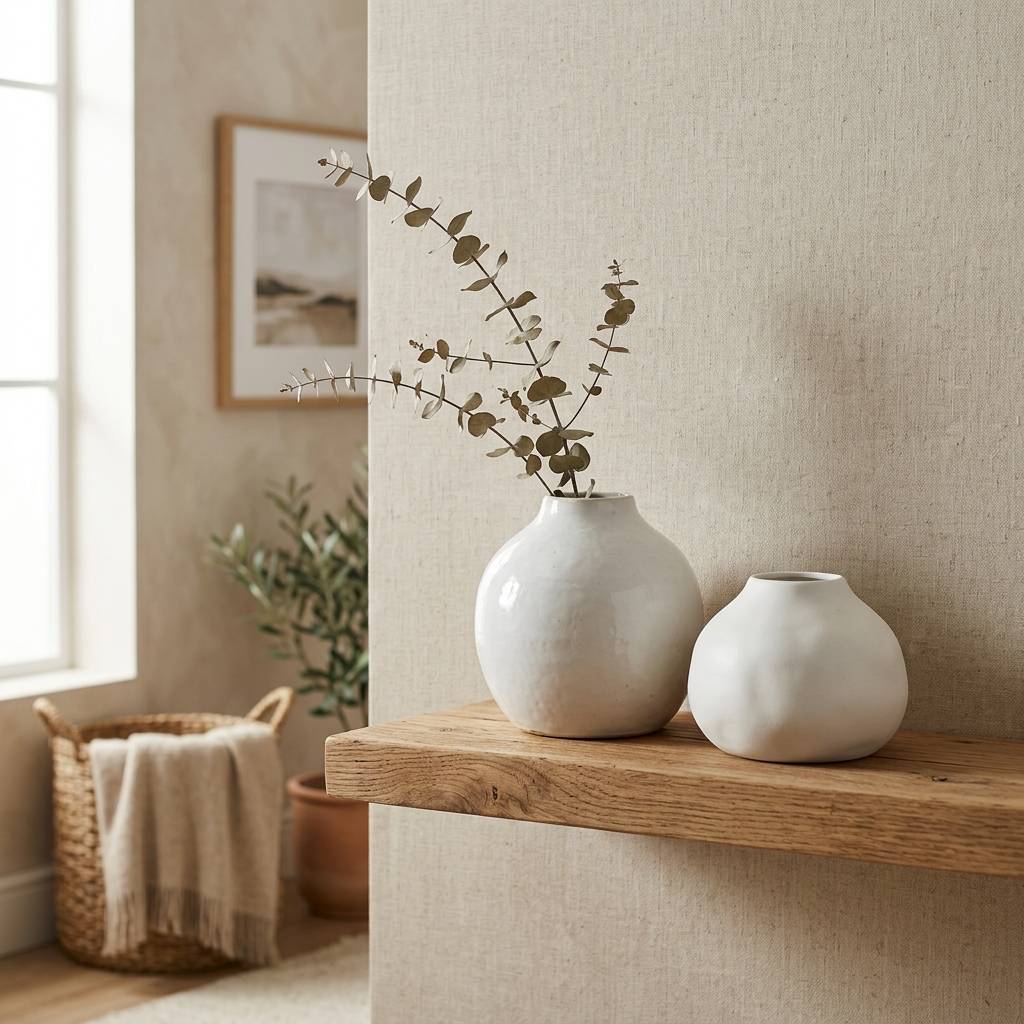
A manufactured set solves this because the designer has already calibrated the relationship: same glaze, complementary shapes, proportioned heights. The milky white Snuggle Hollow set, for instance, uses two rounded organic forms — one slightly taller and wider than the other. The height difference is enough to create visual rhythm without looking like a parent-child pair.
Sets also solve the shopping problem. Instead of visiting three stores, scrolling four websites, and second-guessing every pairing, you buy one item and the relationship is built in. For people who find styling decisions exhausting, a set is a shortcut that does not compromise the result.
Sizing and Proportion
The 6.3 × 8.4 inch dimensions (roughly 16 × 21 cm) place these vases in the medium-small range. That size works on surfaces between 30 and 80 cm wide:
| Surface type | Recommended vase count | Notes |
|-------------|----------------------|-------|
| Side table (30–45 cm) | 1 vase from the set | Both vases crowd a small table; use one and place the other elsewhere |
| Floating shelf (60–90 cm) | Both vases | Leave 10–15 cm between them and 8 cm from the shelf edge |
| Console table (90–120 cm) | Both vases + 1 other object | A book stack, small tray, or candle bridges the gap on wider surfaces |
| Mantelpiece (100+ cm) | Both vases, separated | Place one at each end third for symmetry, or group them off-center with a framed print |
On a side table next to a sofa, one vase from the set is usually enough. The table surface is small, and adding both vases plus a lamp, coaster, and book stack turns the table into a display shelf rather than a functional surface. Use the second vase on a nearby bookshelf, windowsill, or bathroom ledge — the matching finish ties the rooms together without being obvious.
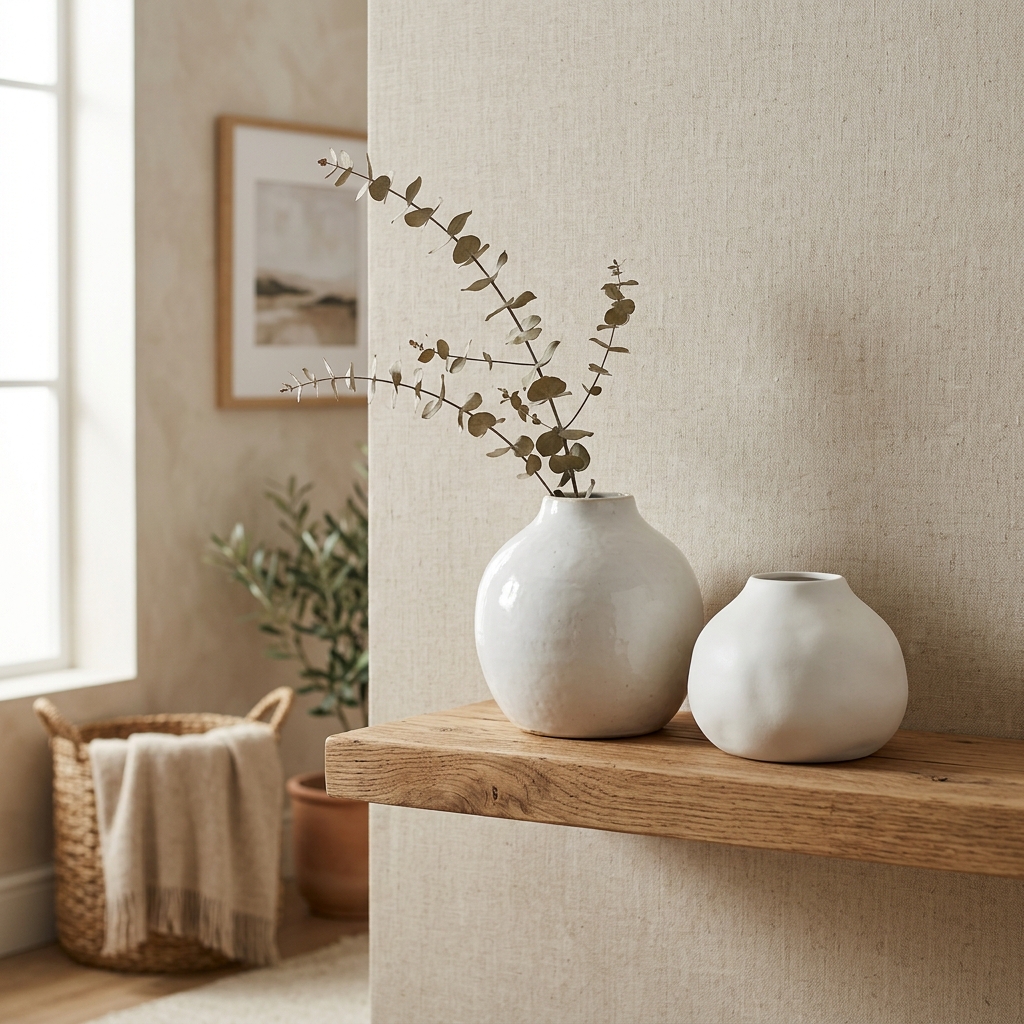
Snuggle Hollow Ceramic Vase Set of 2, Nordic Boho Style (Milky White)
Set of two milky white ceramic vases in a Nordic modern boho style, 6.3×8.4 inches, for shelf styling, side tables, and minimalist home decor.
Milky white ceramic sits comfortably in two broad palettes: warm neutral (cream, sand, oatmeal, warm grey, oak, linen) and boho eclectic (terracotta, sage, rust, woven textures, dried botanicals). The vase works in both because white is the lightest value in both schemes — it provides the visual breath that stops a warm room from feeling heavy.
In a warm neutral room, the vase reads as part of the tonal family. Pair it with a natural wood shelf, a linen runner, or a woven basket. The key is to avoid matching the vase to a wall color that is also white — place it against a warm wall (beige, stone, blush) so the white stands slightly forward.
In a boho room, the vase provides contrast to the heavier textures and deeper colors around it. Terracotta pots, macramé, dark-stained wood, and dried pampas all benefit from a white ceramic anchor that lightens the zone without introducing a cold or modern note. The organic shape prevents the white from reading as clinical.
Avoid placing milky white vases on a white shelf against a white wall. Three layers of similar white flatten the depth and the vases become invisible. In a white-on-white room, add a natural wood shelf, a textured wall hanging behind the vases, or a dark runner underneath to lift them forward.
What to Put in Them
The best approach for a set of two is asymmetry: one vase with stems, one empty.
Dried stems: Eucalyptus, pampas grass, dried bunny tails, wheat stalks, or cotton branches all work. Choose stems that extend 15–25 cm above the vase rim. Stems shorter than the vase look sunken; stems much taller can tip the vase if it is lightweight. One to three stems per vase is enough — more creates a bouquet arrangement rather than a styling accent.
Fresh flowers: A single stem of a sculptural flower — a ranunculus, a garden rose, a protea — works better than a mixed bunch. The vase opening is narrow enough that one stem sits centered without flopping. Change water every two days to prevent film on the interior glaze.
Nothing: An empty vase is a legitimate choice. The rounded ceramic form has enough visual interest to justify itself without contents. Empty vases work especially well in pairs because the shapes create a conversation even without stems. If both vases are empty, separate them by 12–15 cm so each reads as an individual form.
Avoid artificial flowers. Ceramic and silk have very different light qualities, and the combination reads as a compromise. Dried botanicals bridge this gap because they have natural texture and shadow, even though they are not alive.
Placement Formulas
On a shelf: Place both vases in the same third of the shelf rather than centered. Off-center placement creates the sense that the shelf has been curated rather than balanced. If the shelf holds books, place the vases at one end as a bookend grouping. Leave breathing room — 8–10 cm from each shelf edge and 10–15 cm between the two vases.
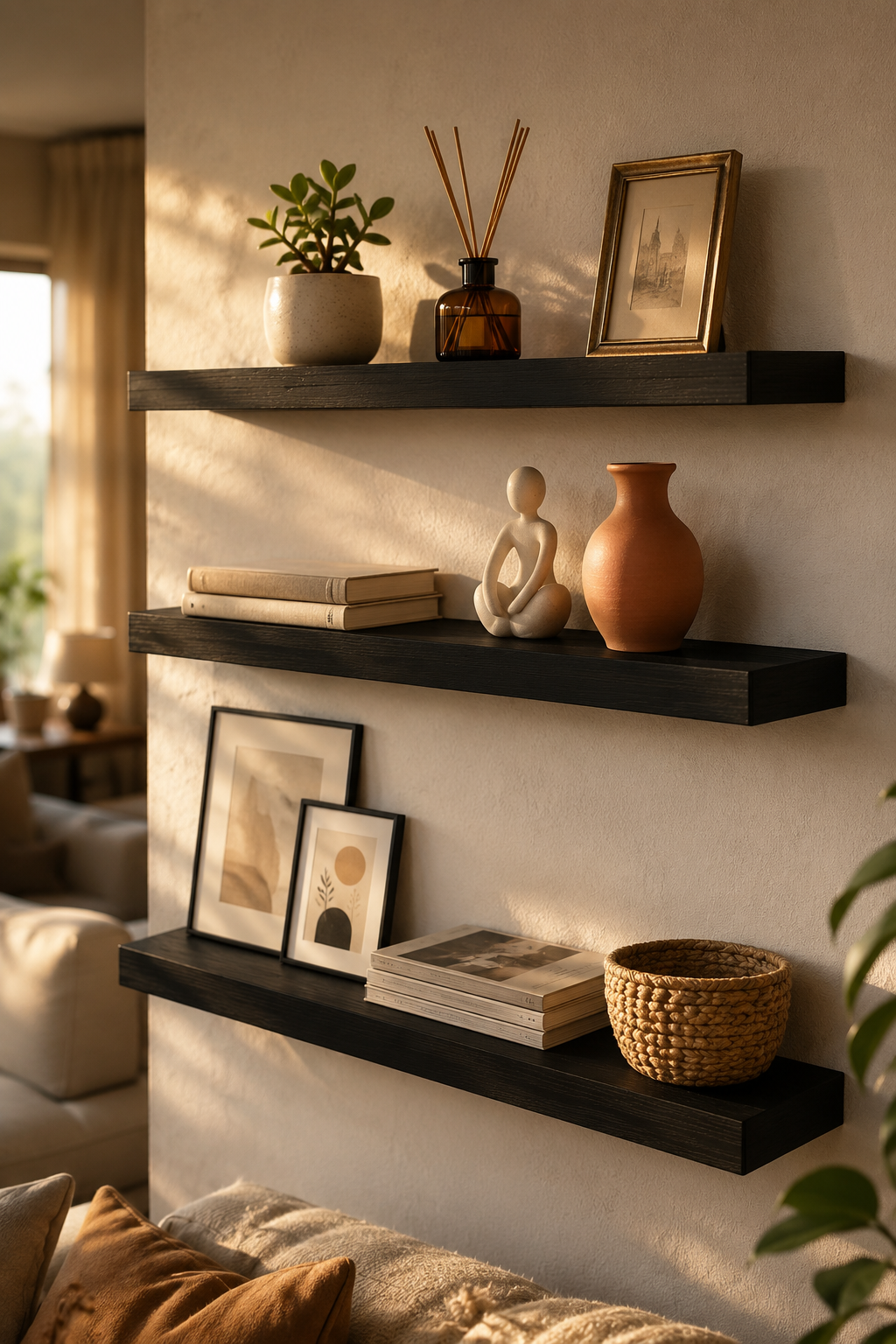
If the room does not have a shelf yet, a set of three floating shelves in a staggered arrangement gives three display levels. Stagger the vases across two shelves — the taller vase on the lower shelf, the shorter on the upper — so the pair creates a diagonal line that the eye follows upward.
BAYKA Black Floating Shelves, Set of 3
Set of three black rustic wood floating shelves for bathrooms, bedrooms, living rooms, kitchens, books, storage, and small-space wall decor.
On a side table: Use one vase, positioned in the back half of the table so it does not block the functional zone where you set down a coffee cup or phone. If the table is round, place the vase off-center. If the table is square, place it in the back corner opposite the lamp. The approach is similar to our advice in five accessories that do the work of a redesign.
On a console: Group both vases with one taller object — a candle, a framed photo leaning against the wall, or a small stack of books. The group of three creates an odd-number arrangement, which reads as more natural than an even-number grouping. Keep the total footprint under one third of the console length.
Care and Durability
Ceramic vases with a glaze finish are low-maintenance but not zero-maintenance.
Dust: Wipe weekly with a dry microfibre cloth. Rounded organic shapes collect dust in the curves more than flat surfaces do. A soft paintbrush reaches the inside of the neck opening.
Water stains: If you use the vases for fresh flowers, empty and rinse within a day of the flowers dying. Standing water leaves mineral rings inside the vase that can become permanent. A vinegar soak (one part white vinegar to four parts warm water, one hour) removes light deposits.
Chipping: Ceramic chips on hard surfaces. Place felt pads under the base — the same pads used for furniture legs work well. On marble or stone surfaces, the pad also prevents the unglazed base from scratching the surface beneath.
Temperature: Do not move ceramic vases from a cold room to a hot surface or vice versa. Thermal shock can cause hairline cracks in the glaze that may not be visible immediately but worsen over time.
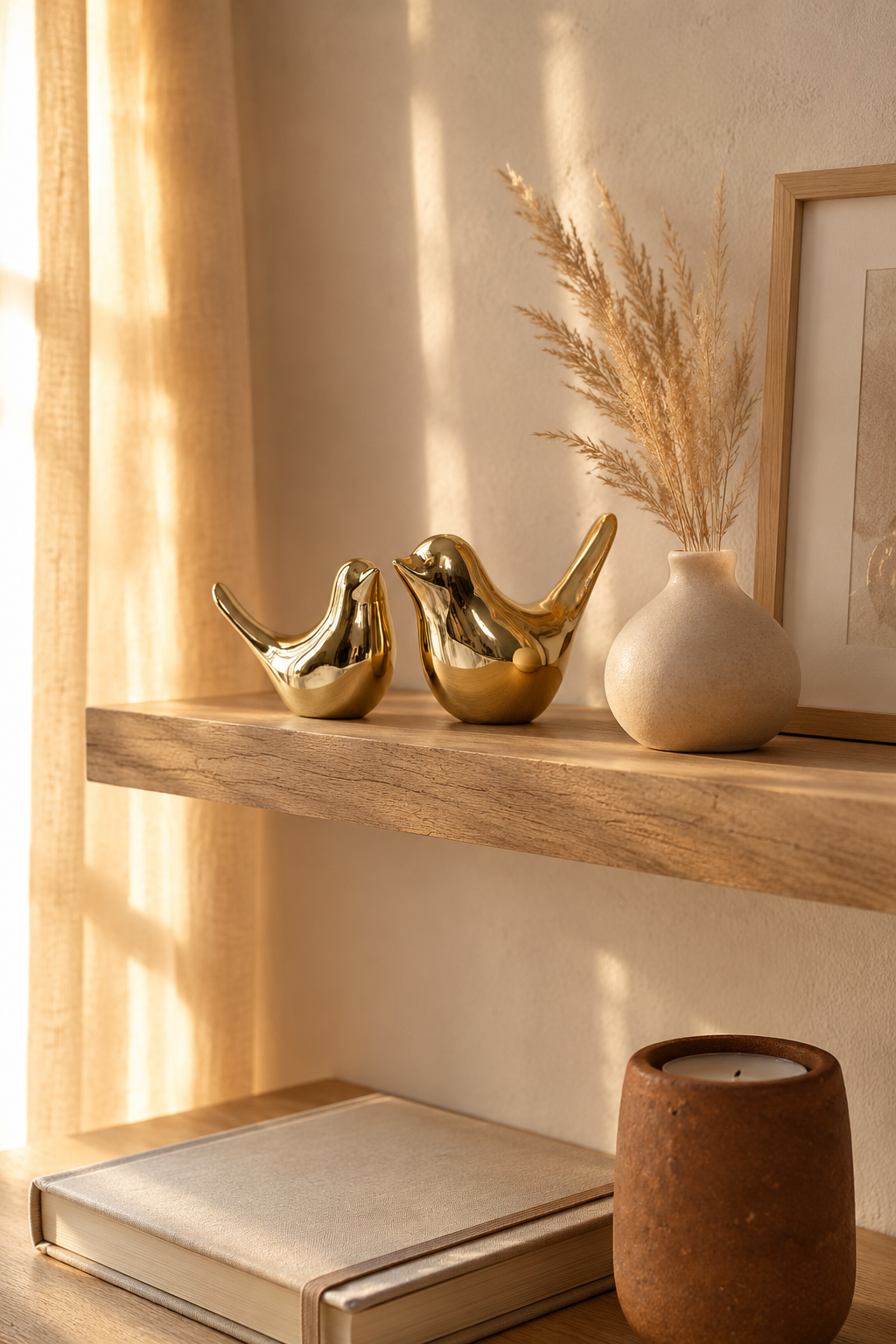
If the vases sit on a shelf alongside other small objects, a pair of gold bird figurines provides a material contrast that lifts the white ceramic. The metallic finish catches light differently from the matte glaze, and the small scale keeps the companion from competing with the vases for attention. Position the figurines beside or between the vases rather than directly in front.
FANTESTICRYAN Gold Bird Figurines
Set of modern gold bird figurines for shelf styling, desks, cabinets, living rooms, bedrooms, and small decorative displays.
Start with one surface. Place both vases on the shelf, table, or console where you spend the most visual time. Live with them for a week before rearranging. The first position is almost never the final one — the light, the sightlines from the sofa, and the interaction with other objects all take a few days to evaluate.
Check the material relationship. The milky white ceramic should echo or contrast with at least one other material nearby. White on natural wood is the easiest pairing. White against dark wall paint is the most dramatic. White beside other white ceramics (a lamp base, a bowl) creates a tonal story that reads as collected.
Separate the vases if the first surface is too small. Using one vase on the side table and one on the bookshelf across the room creates a subtle visual link without overcrowding either surface. The matching finish ties the two zones together — a trick interior designers use to create cohesion in open-plan spaces.
After placing, apply the subtraction rule: remove one nearby small object. A vase set should simplify the surface, not add to the count. If the shelf held six objects before and now holds seven, the vases have added clutter rather than resolved it.
FAQ
Can I use a ceramic vase set outdoors?
Most indoor ceramic vases are not frost-rated. If the vase is unglazed or has a porous body, water trapped in the clay can crack during freezing. For outdoor use, choose vases specifically rated for exterior conditions or use them in covered areas only.
Do I need to put something in both vases?
No. One filled and one empty often looks better than two filled vases, because the empty vase reads as a sculptural form while the filled one reads as an arrangement. The contrast creates interest without doubling the visual weight.
What is the best surface for a ceramic vase set?
Natural wood, marble, or stone shelves complement the matte white ceramic. Avoid glass shelves if the vase has an unglazed base — ceramic on glass can scratch. Place a felt pad under each vase on wood or painted surfaces to prevent scuffing.
How do I clean the inside of a narrow-neck ceramic vase?
Fill halfway with warm water and a tablespoon of white vinegar, let it soak for two hours, then rinse. For stubborn mineral deposits, add a tablespoon of uncooked rice with the vinegar water and swirl gently. The rice acts as a mild abrasive without scratching the glaze.