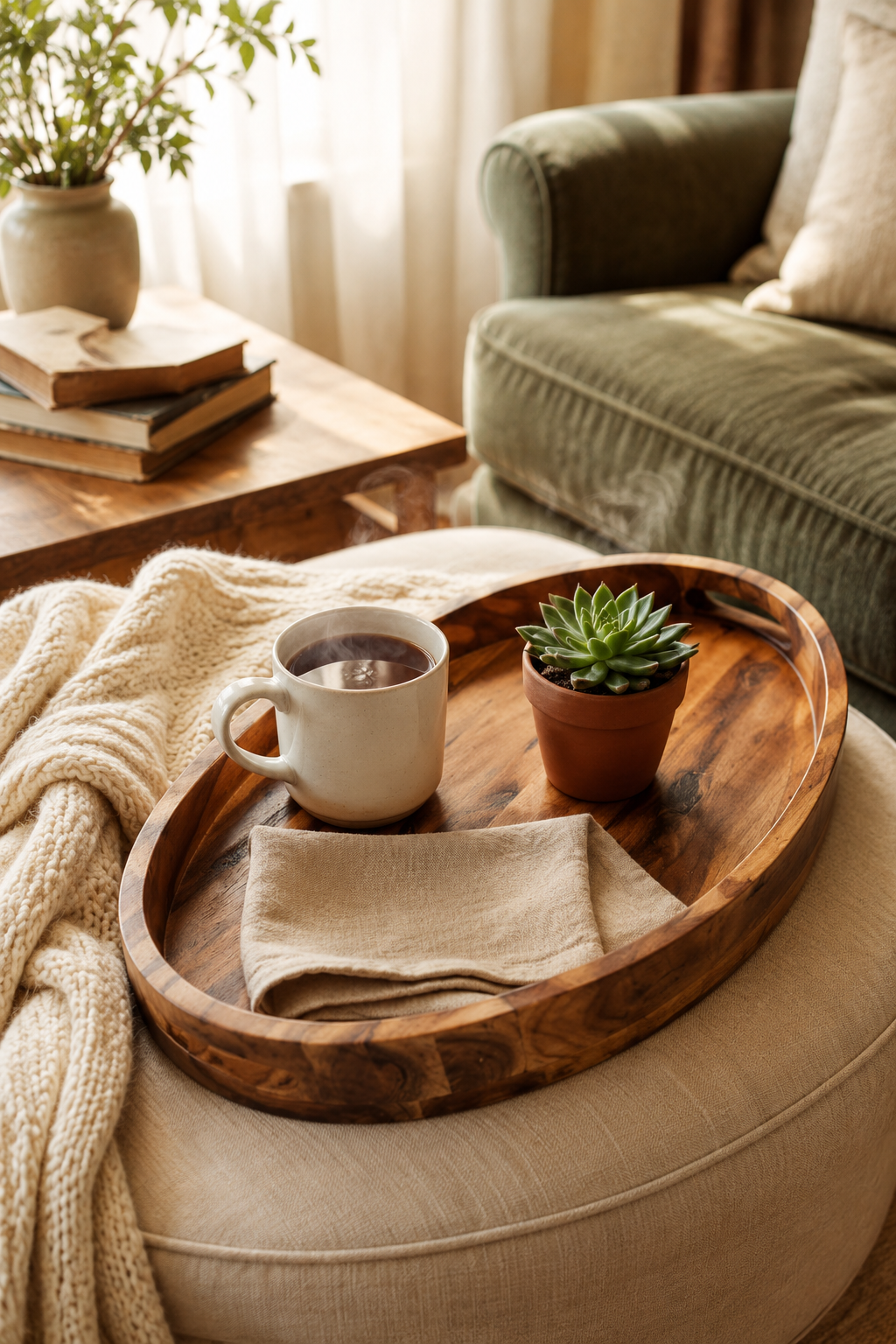
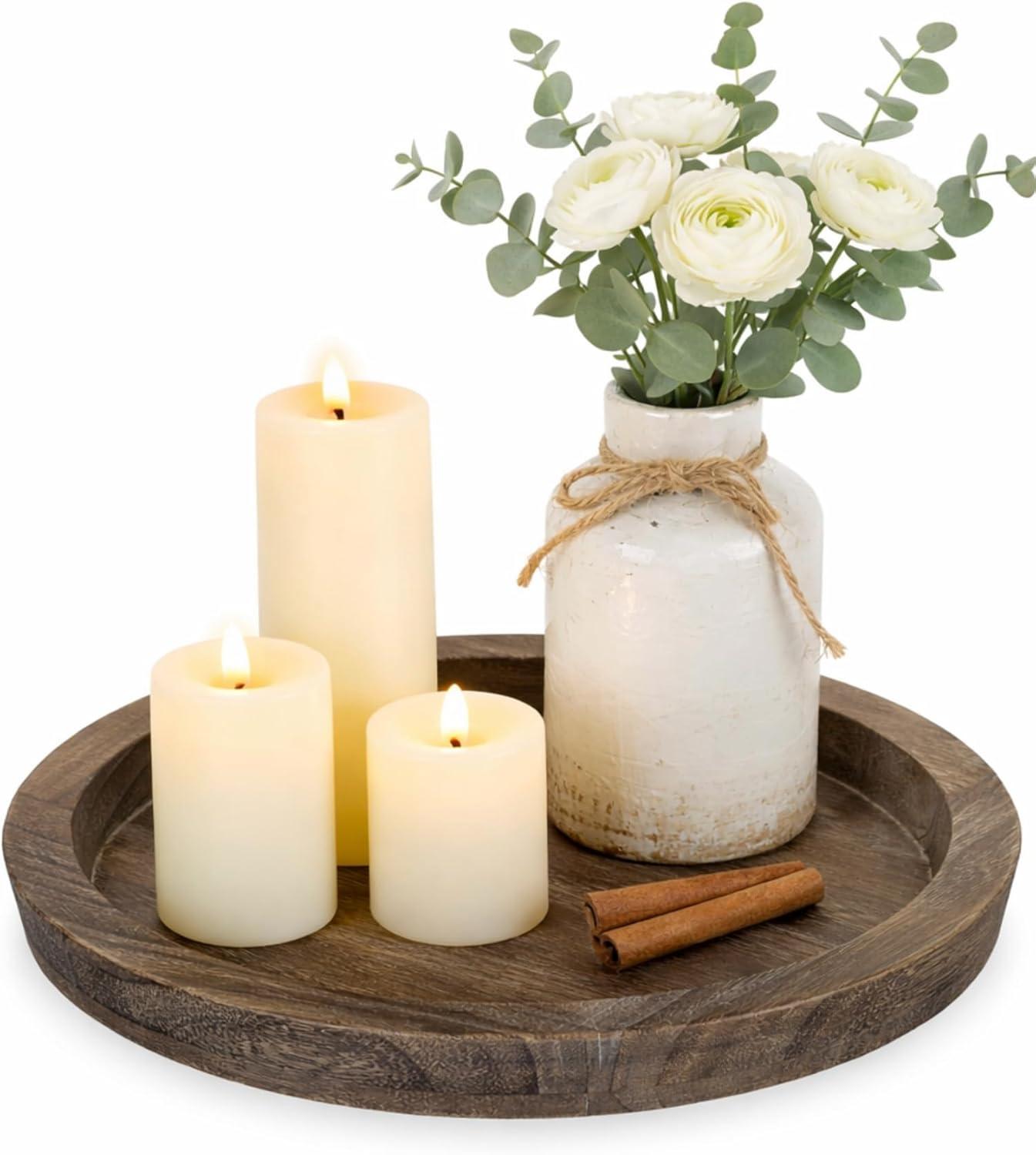
A rustic wood tray turns a coffee table from a random surface into an intentional display — but the objects inside the tray, and how few you use, decide whether it reads as styled or cluttered.
A coffee table without a tray is a flat surface waiting to collect remotes, coasters, half-read books, and whatever else lands on it during the week. A tray changes the relationship. It draws a boundary around a curated set of objects and tells the room: this part is styled, the rest is living space. The tray does not prevent clutter on the rest of the table, but it creates a zone of order that the eye rests on — and that zone is often enough to make the whole room feel more intentional.
I styled a friend's coffee table last February. She had a large oak rectangle, about 120 × 70 cm, and the surface held a laptop, three remotes, a candle that had never been lit, a coaster stack, and a half-empty water glass at any given time. We bought a round distressed wood tray, about 35 cm diameter, placed a pillar candle, a reed diffuser, and a small dried floral sprig inside it, and pushed it to the centre-right of the table. The rest of the table was still messy by Thursday each week, but the tray stayed composed. Visitors noticed the tray, not the clutter. The styled zone anchored the room.
For a broader look at objects that do heavy lifting without renovation, see five things you already own that make a room. For a room-level approach to warm neutral styling, our slow living living room guide covers the full palette. This article focuses on the specific technique: rustic coffee table tray decor with candles, diffusers, and natural materials.
Why a Wood Tray Works on a Coffee Table
A tray provides two things that a bare table does not: containment and elevation. The rim of the tray draws a visual border that groups objects into a composition. Without the tray, the same three items — candle, diffuser, and dried sprig — placed directly on the table look scattered. Inside the tray, they look curated.
The wood material adds warmth that metal and acrylic trays do not. A marble tray reads as modern and cool. A mirrored tray reads as glamorous. A brass tray reads as polished. A wood tray — especially one with visible grain, distressed edges, or a natural bark rim — reads as organic, lived-in, and warm. In a room with linen sofas, cream cushions, and neutral walls, the wood tray extends the material palette rather than introducing a new one.
Round trays are particularly effective on coffee tables because most tables are rectangular or square. The circular form breaks the grid. Your eye moves around the curved edge rather than scanning along straight lines, which creates a sense of softness and organic flow in a room built on right angles.
HouseJoy Acacia Wood Serving Tray with Handles
16.5 x 13 inch acacia wood tray with handles for ottomans, coffee tables, breakfast in bed, bathroom styling, and candle displays.
Tray sizing is the most common mistake. Too small and the tray looks like a coaster with ambitions. Too large and it colonises the table, leaving no room for actual use — setting down a cup, resting a book, or eating from a plate.
| Table size | Tray diameter or width | Notes |
|-----------|----------------------|-------|
| Small (60–80 cm) | 25–30 cm | One tray maximum; keep to 3 objects inside |
| Medium (80–120 cm) | 30–40 cm | Centre or offset to one-third; room to set things beside it |
| Large (120–150 cm) | 35–45 cm | Can use two small trays or one large; avoid covering more than one-third of the surface |
| Round table (70–90 cm) | 25–35 cm | Round tray on round table works if the diameter is less than half the table |
The depth of the tray rim matters too. For a coffee table display, a rim height of 3–5 cm is ideal. This is tall enough to contain objects visually but low enough to reach inside easily. Trays with rims above 7 cm start to look like bowls or boxes and obscure the objects inside from seated eye level.
Building the Tray Composition
The objects inside the tray follow a simple formula: vary height, vary material, keep the count between three and five.
The tall element — usually a pillar candle. A candle between 12 and 18 cm tall anchors the tray vertically. Ivory or cream is the safest colour. Place it slightly off-centre within the tray rather than dead middle.
The medium element — a reed diffuser, small vase, or decorative box. This should be roughly half the candle height. A reed diffuser in a glass bottle adds a translucent material that contrasts with the opaque candle and the wood tray. A small ceramic vase with one dried stem also works.
The low element — a stack of two coasters, a small decorative stone, a tiny potted succulent, or a few dried flower heads laid directly on the tray surface. This fills the base layer and prevents the tray from looking like it has two objects floating in empty space.
Optional extras for larger trays: a small linen napkin folded under the candle, or a single sprig of dried eucalyptus draped across the tray edge. These textile and botanical elements soften the hard surfaces and connect the tray to the room's warmth.
The candle is usually the visual centre of a coffee table tray, so it deserves deliberate selection.
Pillar candles are the standard choice. A pillar sits independently, fills space with its diameter, and creates a substantial vertical element. Choose unscented if you also use a reed diffuser in the tray — competing fragrances create a confusing sensory experience. If the candle is the only scented element, choose a subtle scent: vanilla, sandalwood, linen, or cedar. Avoid strong floral or synthetic fragrances in a living room where people eat, drink, and relax.
Flameless LED candles are the practical alternative. Modern LED pillar candles with a flickering setting produce a convincing warm glow and eliminate fire risk, wax drip, and smoke. For households with children, pets, or a tendency to leave candles forgotten, LED is the responsible choice. Choose LED candles with a warm colour temperature — anything labelled "warm white" or rated at 2700K or below.
Taper candles do not work in tray compositions. They require a holder, they drip, and their height usually extends above the tray's visual zone. Tapers belong in candlesticks on dining tables, not in coffee table trays.
Candle-on-wood safety: even LED candles benefit from a protective barrier between the base and the wood tray. A small glass or ceramic plate under the candle prevents heat damage, wax residue, and moisture rings from condensation.
Seasonal Refreshes Without Replacing the Tray
A good wood tray stays year-round. The objects inside rotate with the seasons. This is one of the tray's strongest advantages — you invest once in the vessel and swap the contents four times a year for a fraction of the cost and effort of buying new seasonal decor.
Spring: fresh greenery sprig (rosemary or eucalyptus), a light-coloured candle, a small potted herb
Summer: a citrus-scented diffuser, a shell or piece of driftwood, a white candle
Autumn: dried wheat or pampas, an amber or ivory pillar candle, a small gourd or acorn
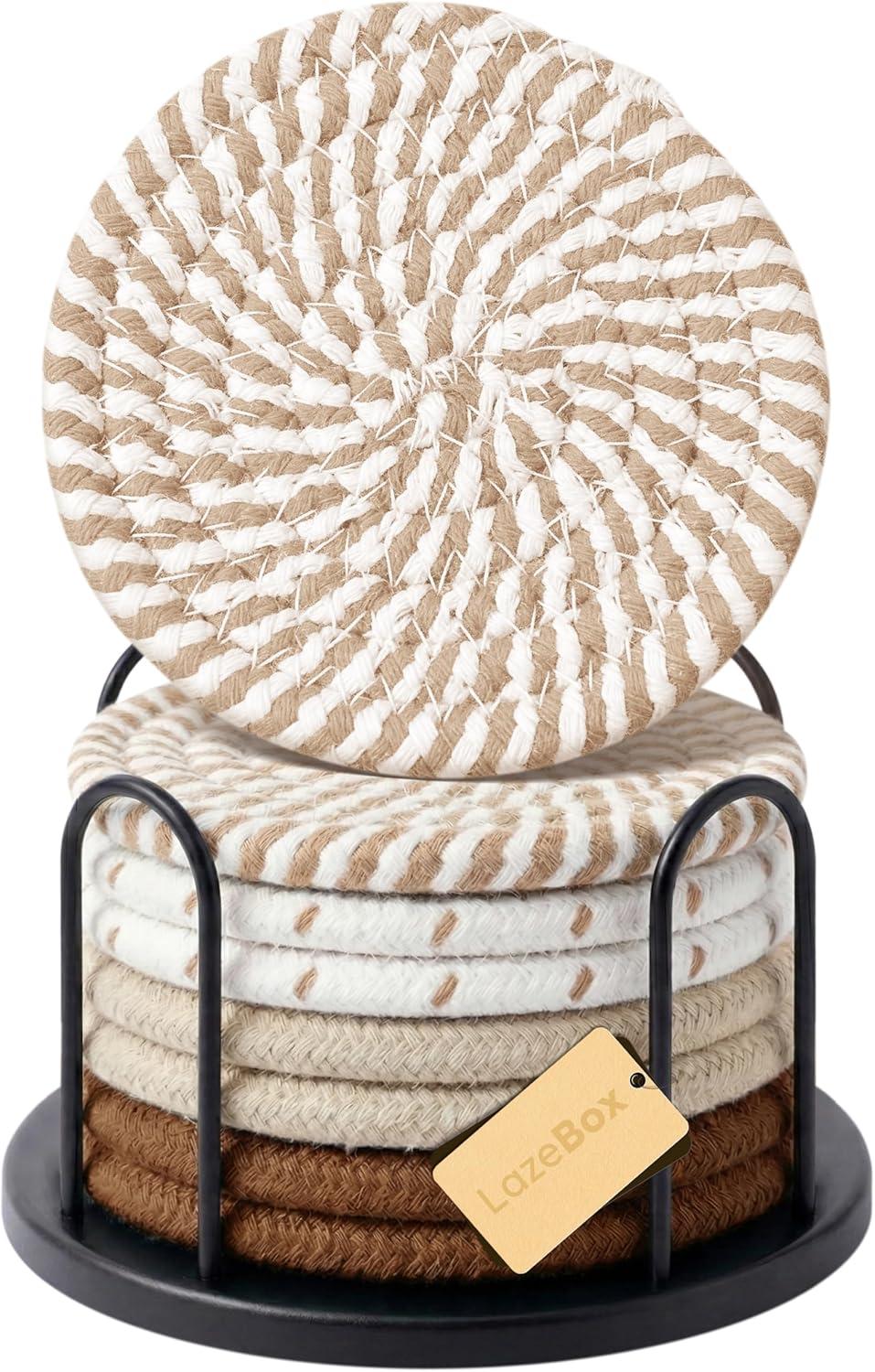
Winter: a pine sprig, a cinnamon stick bundle tied with twine, a cream knit coaster under the candle
The tray's neutral wood tone works with every seasonal palette because natural wood is inherently season-agnostic. A metal or marble tray locks you into a specific temperature (warm or cool). Wood moves with whatever you place inside it.
Common Mistakes to Avoid
Overfilling the tray. The tray should have visible empty space between objects. If the items are packed edge to edge, the tray looks like a storage container rather than a styled display. Empty space inside the tray is as important as the objects.
Using objects that are all the same height. Three candles of the same height in a tray create a flat, static arrangement. Vary the heights across at least a 10 cm range — one tall, one medium, one low — to create visual movement.
Placing the tray dead centre on the table. Centre placement is safe but predictable. Offsetting the tray to one-third of the table creates a more dynamic composition and leaves usable space on the other side for drinks, plates, or books.
Matching the tray finish to the table exactly. A walnut tray on a walnut table disappears. Choose a tray that contrasts slightly in tone, grain, or finish. Acacia on oak, reclaimed wood on polished walnut, or distressed pine on a dark stained table all create enough visual separation to make the tray read as a distinct accessory.
Ignoring the view from seated height. Style the tray from the sofa, not standing above it. The angle from a seated position is how the tray is actually seen most of the time. Objects that look balanced from above may be hidden behind the tray rim from the sofa.
Frequently Asked Questions
Can I use the tray for serving when guests come?
Yes — that is the practical beauty of a serving tray on a coffee table. Remove the styled objects, use the tray to carry drinks or snacks to the table, and restyle it after the guests leave. A tray that serves double duty is more sustainable than a purely decorative one.
Does the tray need to stay in the same spot?
No. Move it to the dining table for a seasonal centrepiece, to the entryway console for a welcome display, or to the bedroom nightstand for a cozy evening vignette. The portability of a tray composition is its advantage over objects placed directly on a surface.